Case study 02
Saved Content Has Intent: Turning Saved Posts into Career Action
A product management case study that transforms LinkedIn’s flat saved-post archive into Smart Collections built for retrieval and action.
Context
LinkedIn’s Save feature captures strong user intent across job descriptions, interview guides, industry reports and creative inspiration. But retrieval happens through a single chronological archive, so useful content quickly loses its context.
The opportunity is to turn saving from a passive archive into a reliable bridge between discovery and career action.
Problem statement
Users treat saved posts like a to-do list, while the product treats them like a flat archive. High-intent career content gets buried under low-signal posts, creating a ‘junk drawer’ where users struggle to find what they saved when it matters.
- Cognitive load rises as users scan dozens of unrelated saved items.
- Context disappears because users cannot preserve why a post was saved.
- The case-study hypothesis estimates successful retrieval at 20% and action taken below 5%.
User needs
Three behavioural profiles reveal different jobs for the same saved-content system.
- Job seekers need interview guides, application advice and company research at the moment of preparation.
- Professionals need a dependable reading system for reports, market shifts and long-term learning.
- Creators need an organised swipe file for hooks, formats, charts and content inspiration.
Proposed solution: Smart Collections
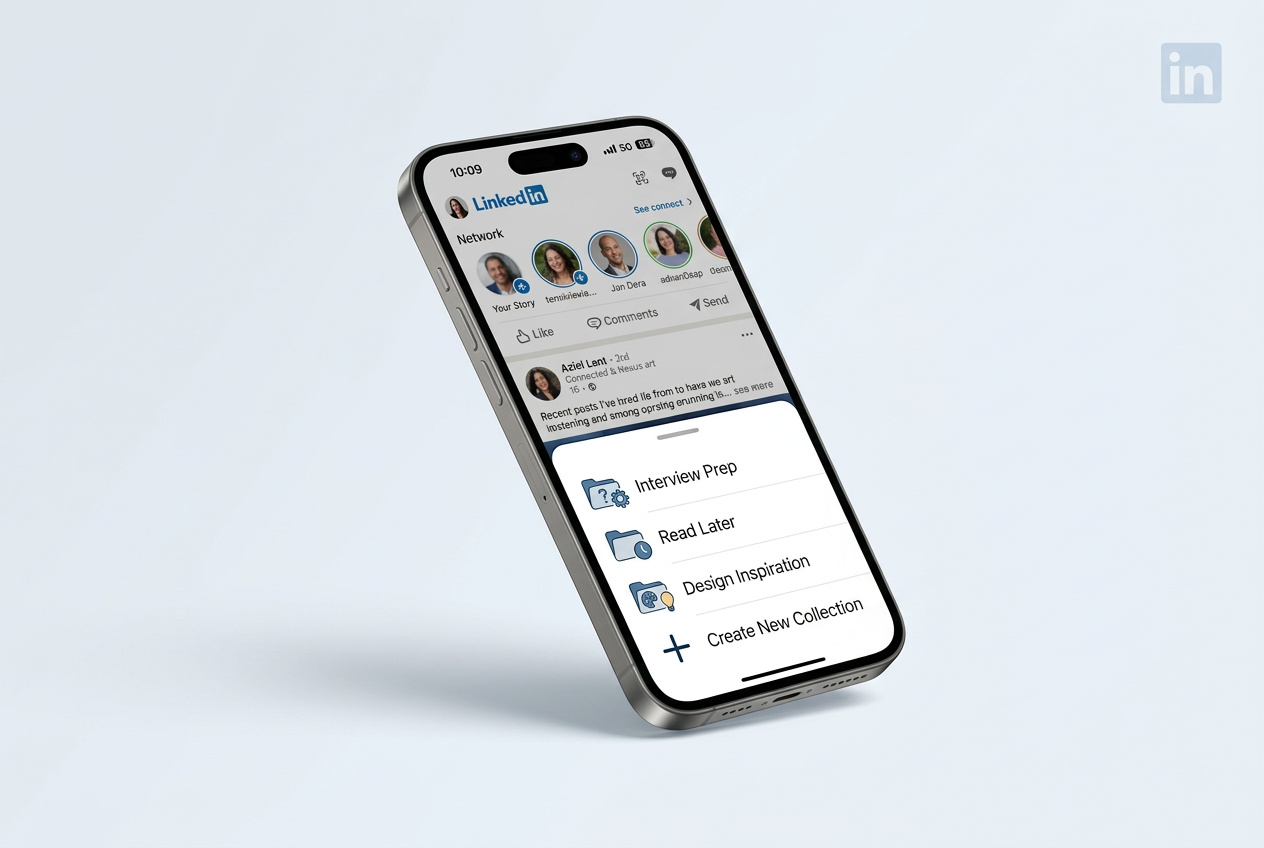
Smart Collections introduces one-click categorisation at the moment of saving, a searchable visual collection grid and an uncategorised area for items that have not yet been sorted.
Example collections such as Interview Prep, Industry Insights, Career Development and Design Inspiration preserve the user’s original intent and reduce later search effort.
Why this solution
The concept upgrades an existing habit rather than asking users to learn a new workflow.
- Frictionless categorisation shifts effort from searching later to sorting once at capture.
- Visual collections replace an infinite mixed list with recognisable retrieval cues.
- Collection metadata can improve recommendation relevance by revealing deterministic interest signals.
- The concept builds on the existing Save system by adding collection metadata and a new retrieval interface.
Journey redesign
The current path moves from discovery to saving, then through time-based decay and manual scrolling before users often abandon retrieval. The proposed path moves from discovery to organised saving, automatic context preservation, collection-level retrieval and actionable use.
Metrics & rollout
The north star is 7-day retrieval rate: the percentage of saved items reopened within seven days. The projected metric bet is a 3× increase in that rate and should be validated through experimentation rather than treated as a reported result.
- Adoption: categorisation rate and collection creation rate in the first 30 days.
- Guardrails: overall save-volume drop-off and time-to-save latency.
- Option one: a persona-led beta with Premium members or active creators.
- Option two: a phased A/B test with 5% of users against the current Save experience.
Learnings
A save is not a low-value bookmark; it is a declaration of future intent. Product value is created when the system preserves that intent, shortens retrieval and helps the user complete the action they had in mind.